Mystical Umbria: Assisi, Spello and the Franciscan Hermitages
Discover Assisi with Basilica of San Francesco and Santa Chiara, Eremo delle Carceri in the woods, San Damiano where the crucifix spoke, and Spello village of flowers. Complete itinerary between spirituality and beauty. Map included.
There's a corner of Umbria where time slows down and the soul breathes. Assisi welcomes you with its basilicas guarding absolute masterpieces, Spello conquers you with flowered alleys and the silence of authentic villages, the Franciscan hermitages take you into the woods where Francis prayed under centuries-old holm oaks. It's a journey into true spirituality, the kind you breathe walking on millenary stones, entering churches scented with incense, getting lost among olive groves and silences. A mystical, profound Umbria that changes you.
From Chiusi to Mystical Umbria: A Journey into the Soul
Imagine driving through green hills, arriving in Assisi and feeling the atmosphere change. You walk where Francis walked, see Giotto's frescoes telling his life, enter the cave where he prayed under centuries-old holm oaks, stop before the crucifix that spoke to him. Then you climb to Spello, get lost among flowered alleys and discover Pinturicchio's frescoes hidden in a church. It's a journey that nourishes the soul, believer or not: sublime art, powerful nature, authentic spirituality, moving beauty.
🌅 MORNING: Assisi, the city of Francis and Clare (09:00-13:00)
You arrive in Assisi and immediately understand why it's a unique place in the world. The city climbs the slopes of Monte Subasio, medieval walls still surround it intact, and above everything stands the Rocca Maggiore watching over the valley. But it's not the architectural structure that takes your breath away: it's the atmosphere. There's something in Assisi's air, a quiet yet powerful energy, that accompanies you step by step.
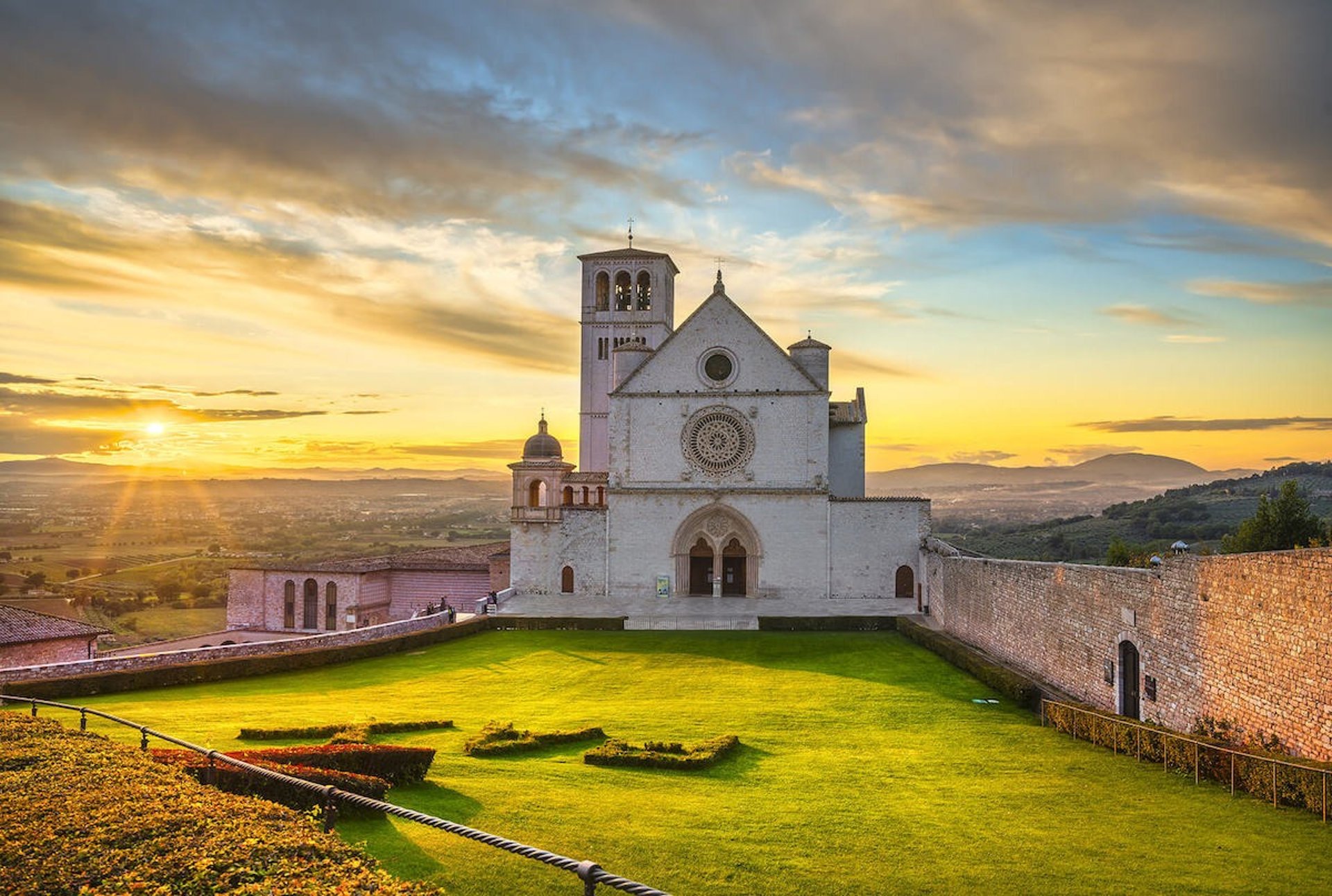
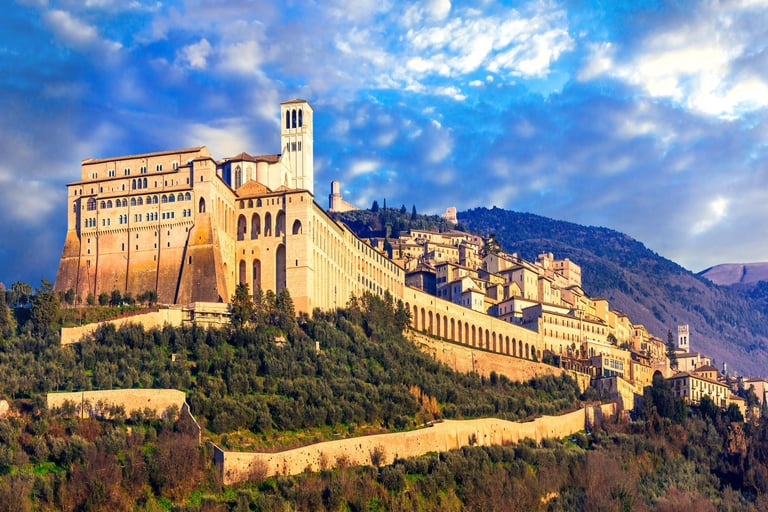
You start from the Basilica of San Francesco, the city's symbol and one of Italian art's absolute masterpieces. Actually it's two churches stacked: the Lower Basilica, intimate and collected, where Saint Francis's body rests in the crypt, with frescoes by Cimabue and Giotto covering walls and vaults; and the Upper Basilica, luminous and solemn, where Giotto's frescoes tell the Saint's life in 28 scenes that seem alive. It's an experience beyond religion: pure art, history, moving beauty.
From here you walk toward the old town, crossing alleys of pink Subasio stone. Piazza del Comune is the city's heart: on one side the Temple of Minerva, perfectly preserved from Roman times, on the other the Palazzo dei Priori with the civic tower. Everything is human-scale, everything smells of history.
You continue toward the Basilica of Santa Chiara, built with the same white and pink stone characterizing Assisi. The façade is simple yet imposing, with three large flying buttresses on the side. Inside, in the crypt, rest the remains of Saint Clare, the woman who followed Francis renouncing everything. But the real treasure is in the side chapel: the Crucifix of San Damiano, the one that according to tradition spoke to Francis telling him "Go and repair my house." It's a peculiar crucifix: Christ shows no suffering but seems to open his arms in an embrace of hope. Before it, time stops.
If you still have time before lunch, it's worth climbing to the Rocca Maggiore: the view spans the entire Umbrian valley, from Perugia to Spello, and the panorama rewards the climb.
📍 Podere's tip
Arrive early, around 8:30. The Basilica of San Francesco opens at 8:30 and at 9 it's still quiet, without groups. Dedicate at least an hour and a half to the double basilica: don't rush, sit down, observe the frescoes, breathe the silence. And at the Basilica of Santa Chiara, stop in front of the Crucifix of San Damiano: it's one of those moments you'll remember forever.
🍽️ LUNCH: Assisi center (13:00-14:30)
For lunch you're spoiled for choice. If you want authentic Umbrian cuisine in a historic place, Trattoria Pallotta (Piazza del Comune, under the frescoed Volta Pinta arch) welcomes you with traditional dishes prepared with local and organic ingredients: strangozzi with porcini mushrooms, grilled lamb, torta al testo. Or Trattoria degli Umbri (Piazza del Comune) with regional cuisine and terrace overlooking the valley.
If you're looking for something quicker but typical, AssaggiAssisi (Via Borgo Aretino, near Santa Chiara) is perfect: tastings of Umbrian products, cold cuts, cheeses, and then a sandwich stuffed with what you chose, to eat at the viewpoint with breathtaking views. Cheap, fast, delicious.
📍 Podere's tip
If you're not in a hurry and want a special experience, skip lunch downtown and go directly to Eremo delle Carceri. There's the restaurant Gli Eremi (Via Eremo Carceri), a unique place: few tables, long wooden benches where you eat sharing, simple and authentic Franciscan atmosphere. Pappardelle with wild boar, stew, local products. It's a different way to experience Assisi.
☀️ AFTERNOON: Eremo delle Carceri + San Damiano + Spello (14:30-18:30)
Eremo delle Carceri (14:30-15:45)
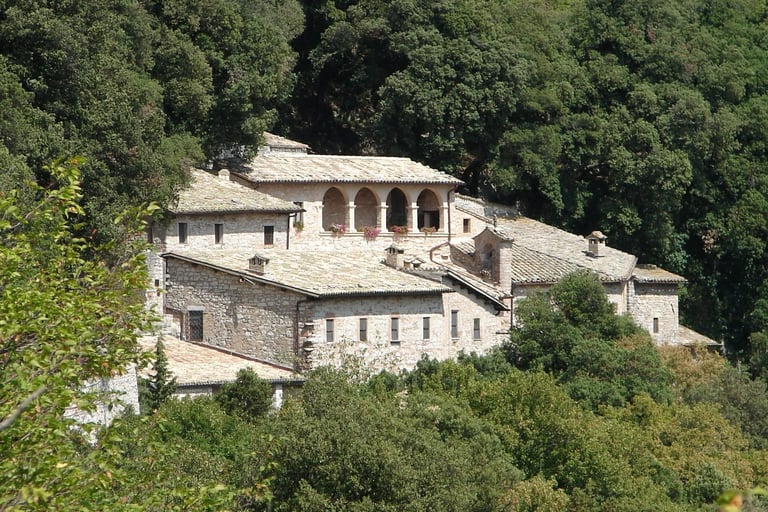
You leave the center and after just 10 minutes uphill you're in another world. The Eremo delle Carceri stands at 800 meters altitude, in the heart of a centuries-old holm oak forest on Monte Subasio. Here Francis and his first companions came to "imprison themselves" – that is, retreat – in prayer and meditation. The word "carceri" doesn't mean prison, but secluded and solitary place.
You park in front of the hermitage (free parking) and as soon as you get out of the car, silence envelops you. It's a dense, full silence, broken only by bird songs and wind rustling through the holm oaks. You visit the small convent built in the 15th century around the original caves: the tiny cloister with Saint Francis's well, the very small church, and then – going down a narrow staircase – Saint Francis's Cave, where the Saint prayed lying on bare rock. Outside, a bridge connects the hermitage to the other friars' caves, scattered in the woods.
The atmosphere is mystical, intense. Here you understand what it means to seek God in nature's silence. Even if you're not a believer, this place touches your soul.
📍 Podere's tip
San Damiano can be visited in 30-40 minutes, but it's worth staying longer. Sit in the cloister, walk in the little garden, breathe the atmosphere. It's one of the few Franciscan places that remained truly intact, without mass tourism. Free entry, open all day. A gift.
San Damiano (16:00-17:00)
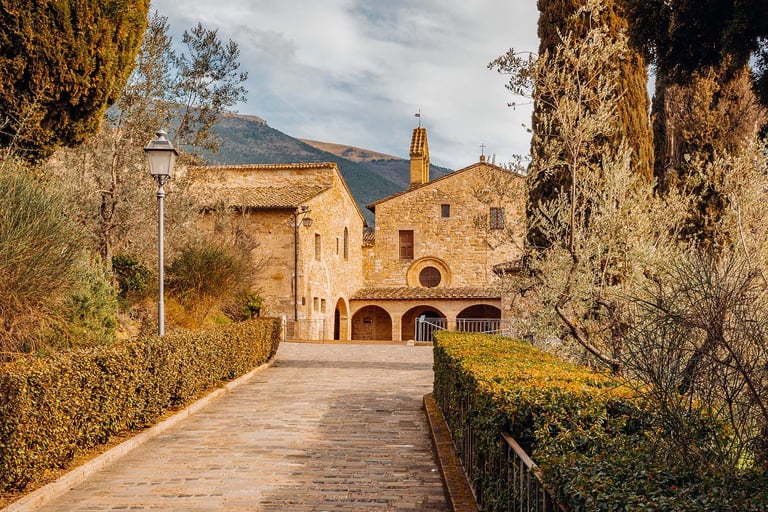
You descend from the hermitage and in 10 minutes you're at San Damiano, one of the most moving stops on the Franciscan journey. This small church among the olive groves is where it all began: here Francis, in 1205, entered to pray before the crucifix and heard it speak to him: "Francis, go and repair my house which is falling into ruin." The Saint interpreted the invitation literally and restored the small church with his own hands.
A few years later, here he welcomed Saint Clare and her first companions, who lived at San Damiano from 1211 to 1260. And here, in 1225, sick and almost blind Francis composed the Canticle of the Creatures, the first poetic text in Italian language.
You visit the simple and bare church, the silent cloister, the refectory where the Poor Clares ate (Saint Clare's place still marked), the oratory where she prayed, and the dormitory where she died on August 11, 1253. A cross on the wall marks the exact spot. Everything remained as it was then: poor, essential, authentic. Saint Clare's hanging garden offers a sweet view over the olive groves.
San Damiano is a place that enters inside you. Silent, collected, full of peace. If the Hermitage is retreat into wild nature, San Damiano is contemplation in simplicity.
📍 Podere's tip
Don't limit yourself to a quick visit. Walk in the woods, sit on a bench, breathe. The path starting from the hermitage leads to stunning viewpoints over the valley. Even just 20 minutes of silence here are worth more than an hour of photos. And look for the large centuries-old holm oak in front of the hermitage: according to legend, birds perched on the branches to listen to Francis (although the real sermon to the birds happened elsewhere).
📍 Podere's tip
Arrive in Spello around 5 pm, when the afternoon light is golden and the alleys empty. Park outside the walls (free parking), enter through Porta Consolare, visit Santa Maria Maggiore (closes at 6:30 pm in summer, earlier in winter), then get lost in the alleys. If you feel like an aperitif, the center's wine bars serve excellent Umbrian wines with platters of local cold cuts and cheeses.
Spello, the village of flowers (17:15-18:30)
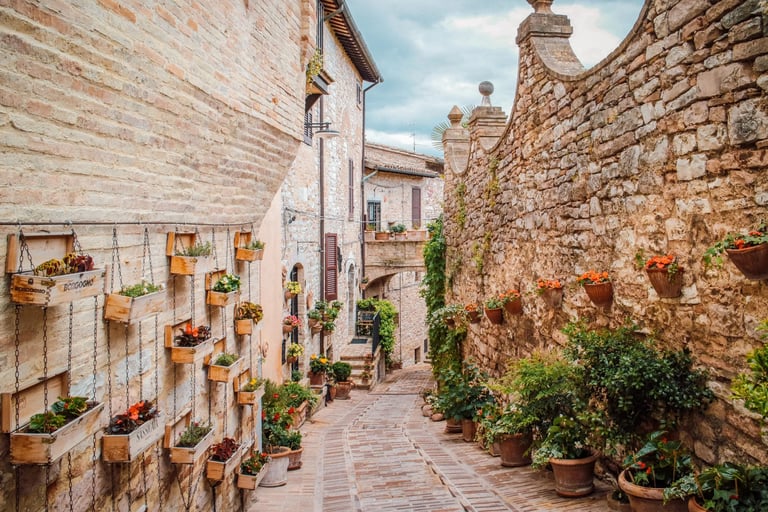
Last stop: Spello, just 15 minutes from Assisi. If Assisi is the city of spirituality, Spello is the village of pure beauty. It welcomes you with cobbled alleys, balconies overflowing with flowers, honey-colored stone houses, the scent of wisteria and jasmine. Spello is famous for the Corpus Domini Infiorata (late May-early June), when 1.5 km of streets are covered with spectacular flower carpets. But even without the Infiorata, Spello is an open-air garden year-round.
You enter through Porta Consolare, the monumental Roman gate with an olive tree growing on top. You climb Via Consolare and get lost among flowered alleys, hidden squares, artisan shops. Must-see stop: the Church of Santa Maria Maggiore, which houses the Baglioni Chapel frescoed by Pinturicchio. The Renaissance frescoes are of dazzling beauty: the Annunciation, the Nativity, Jesus among the Doctors. Vivid colors, minute details, Deruta majolica floors. A hidden jewel.
If you have time, also visit the Villa dei Mosaici (outside the walls): 500 sqm of recently restored Roman mosaics, depicting scenes of banquets, harvest, hunting. A recent and extraordinary archaeological discovery.
But Spello's magic is simply walking aimlessly: every corner is photogenic, every alley smells of flowers, every staircase hides a surprise. It's the perfect village to close an intense day, slowing down and savoring Umbria's quiet beauty.
🌟 IF YOU HAVE TIME: Porziuncola and Basilica of Santa Maria degli Angeli (BONUS)
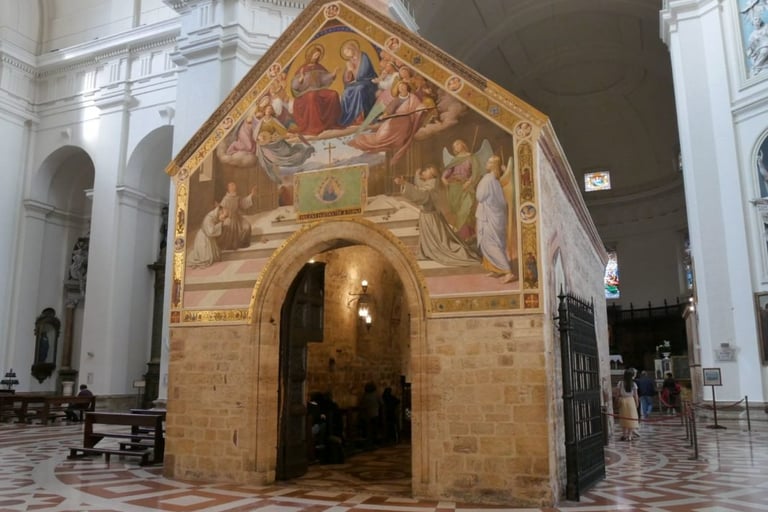
If you have extra time or want to complete the Franciscan path, there's one last unmissable place: the Porziuncola, housed inside the Basilica of Santa Maria degli Angeli (at the foot of Assisi, near the station).
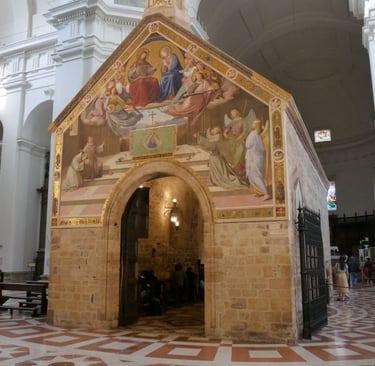
The Porziuncola is a very small Romanesque church that Francis restored and which became the heart of the Franciscan movement. Here Francis founded the Order of Friars Minor, here he welcomed Saint Clare on the night of her escape, here he composed the Canticle of the Creatures, and here he died in October 1226, lying on bare earth.
In the 16th century they built the enormous Basilica of Santa Maria degli Angeli around the Porziuncola to protect it and allow pilgrims to visit it. The contrast is striking: the basilica is gigantic and sumptuous, the Porziuncola is tiny and bare. But it's precisely this contrast that makes you understand Francis's greatness: absolute simplicity at the heart of magnificence.
Next to the Porziuncola is the Chapel of the Transit, where Francis died. Small, poor, moving.
📍 Podere's tip
The Porziuncola is a quick stop (30 minutes) but intense. Worth it if you have time, especially if the Franciscan journey touched you. Entering the tiny church, after seeing the Basilica of San Francesco, really makes you understand who Francis was: one who chose radical poverty in a world of power and wealth.
PRACTICAL INFO
📍 Distance from Podere
- Chiusi → Assisi: 70 km (1h)
-Complete itinerary: ~150 km
⏱️ Things to know
- Assisi Parking: Mojano parking (€1.50/hour) or Porta Nuova near Santa Chiara. Pedestrian old town.
- Basilica San Francesco: Free entry. Decent clothing (no shorts, no bare shoulders). Absolute silence. Photos forbidden in the crypt.
- Eremo delle Carceri: Free entry. Open 6:30-19:00 (summer), 6:30-18:00 (winter). Free parking.
- San Damiano: Free entry. Open all day. Parking nearby.
- Santa Maria Maggiore Spello: €3. Includes Baglioni Chapel (Pinturicchio). Closes 6:30 pm summer, earlier winter.
- Villa dei Mosaici Spello: €9 (€14 with guide). Outside walls, parking nearby.
- Infiorata Spello: Late May-early June, Corpus Domini Sunday. Check exact dates on Municipality website.
- Restaurants: Book especially on weekends in Assisi. Spello is quieter.
- Time needed: This itinerary requires a full day. If you want to visit everything calmly, consider sleeping in Assisi and dedicating two days.
🌅 Seasonality
- Spring (March-May): Ideal. Mild climate, lush nature, Spello covered with flowers. Infiorata late May-early June (check exact dates).
- Summer (June-August): Hot but beautiful. Assisi crowded but the atmosphere remains magical. Hermitages offer coolness. Bring water.
- Autumn (September-November): Perfect. Mild temperatures, stunning autumn colors, fewer tourists. October is the best month.
- Winter (December-February): Evocative but cold. Assisi silent and collected, amplified mystical atmosphere. Bring heavy jacket.
Ready to experience mystical Umbria, where every stone tells a story and every silence speaks to the soul?
Podere Grotta Antica is your perfect base: one hour from Assisi, you wake up in the Tuscan countryside and in one day explore Italy's spiritual heart. After an intense day among basilicas, hermitages and villages, you return home for a quiet dinner and a night in a 17th-century farmhouse. Umbria and Tuscany within reach, peace as a lifestyle.